
 By
By 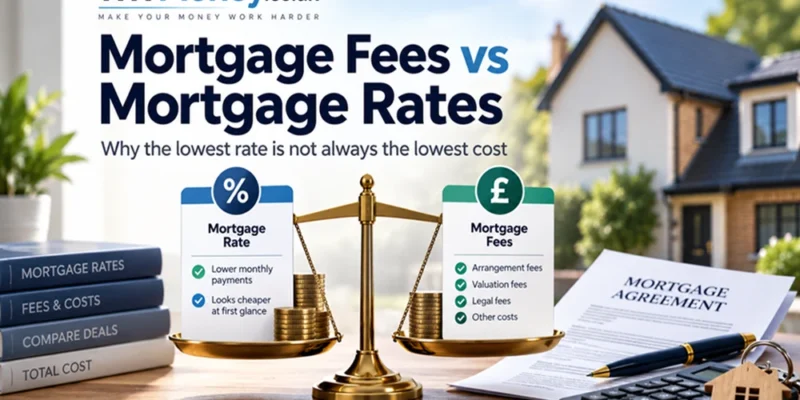
When comparing mortgages, it is easy to focus on one number above all others: the interest rate.
A lower mortgage rate usually means lower interest charges, but it does not automatically mean the mortgage will be cheaper overall. Arrangement fees, booking fees, valuation costs, cashback incentives and the length of the introductory deal can all change the true cost of borrowing.
For UK homebuyers and remortgagers, the most useful comparison is often not simply “Which mortgage has the lowest rate?” but:
“Which mortgage costs me the least over the period I expect to keep it?”
Borrowers researching different options can use WiT Money’s mortgage comparison guides to explore mortgage types, rates and key features available in the UK.
Why the Headline Mortgage Rate Can Be Misleading
Mortgage providers often advertise their most competitive rates prominently because the rate has a major effect on monthly repayments.
For example, a mortgage at 4.2% will generally have lower monthly interest costs than the same mortgage at 4.5%.
However, the lower-rate deal may come with a large product fee.
A typical comparison might look like this:
Mortgage A
- Interest rate: 4.20%
- Product fee: £1,999
Mortgage B
- Interest rate: 4.45%
- Product fee: £0
At first glance, Mortgage A appears cheaper because the rate is lower.
But whether it actually saves money depends on:
- the mortgage balance
- the length of the fixed or introductory period
- whether the fee is paid upfront or added to the loan
- how long the borrower keeps the mortgage
- any cashback or incentives
For a relatively small mortgage balance, paying a large fee to secure a slightly lower rate may not make financial sense.
The Bigger the Mortgage, the More Important the Rate Usually Becomes
Mortgage size plays a major role in determining whether a low-rate, high-fee deal is worthwhile.
Consider two borrowers:
- Borrower A has a £100,000 mortgage
- Borrower B has a £400,000 mortgage
A 0.25 percentage point rate saving will usually be worth much more to Borrower B because the lower rate applies to a much larger balance.
That means high-fee mortgages can sometimes make more sense for borrowers with larger loans, while fee-free or low-fee deals may be more attractive for smaller mortgages.
This is why comparing mortgages only by rate can be misleading.
Product Fees Can Add Thousands to the Cost
Mortgage product fees can vary significantly.
Common charges may include:
- arrangement fees
- booking fees
- completion fees
- valuation fees
- legal fees
- broker fees
- transfer fees
Some mortgages charge no product fee at all, while others may charge £999, £1,499, £1,999 or more.
If the mortgage fee is added to the loan rather than paid upfront, interest may also be charged on that fee.
For example, adding a £1,500 fee to the mortgage means you are effectively borrowing that additional £1,500 as well.
Over time, that increases the true cost of the deal.
Compare the Total Cost Over the Introductory Period
One of the best ways to compare mortgage deals is to calculate the total cost over the fixed or introductory period.
For a two-year fixed mortgage, this could include:
24 monthly payments + product fee + other unavoidable charges
For a five-year fixed mortgage:
60 monthly payments + product fee + relevant charges
This provides a much clearer picture than comparing rates alone.
Two mortgages can have very different headline rates but produce similar total costs.
In some cases, the higher-rate mortgage may actually be cheaper once fees are included.
Fee-Free Mortgages Can Be Attractive for Smaller Loans
Fee-free mortgages are often overlooked because their headline rates may be slightly higher.
However, they can be attractive for:
- borrowers with smaller mortgage balances
- people planning to move soon
- short-term fixed-rate borrowers
- remortgagers who want to minimise upfront costs
Imagine a borrower has a mortgage of £80,000.
Paying a £1,999 product fee to save a small amount of interest each month may take years to recover.
If the borrower plans to remortgage again in two years, the fee may never be fully offset by the lower rate.
In this situation, a fee-free mortgage with a slightly higher interest rate could produce a lower overall cost.
High-Fee Mortgages May Suit Larger Balances
The opposite may apply to large mortgages.
Suppose a borrower has a £500,000 mortgage.
A reduction of 0.30 percentage points in interest can produce a much larger monthly saving than it would on a £100,000 mortgage.
In this case, paying a substantial arrangement fee may be worthwhile because the interest saving across the fixed period can exceed the upfront fee.
This is why borrowers should compare mortgage deals using their own loan balance rather than relying on general assumptions.
Cashback Can Change the Calculation
Some mortgage deals offer cashback.
For example:
- Mortgage A: 4.30% rate, £999 fee, no cashback
- Mortgage B: 4.40% rate, no fee, £500 cashback
Mortgage B has the higher interest rate, but the combination of no product fee and £500 cashback may make it cheaper for certain borrowers.
Cashback is particularly relevant for first-time buyers and remortgagers who may have other moving or legal costs.
However, cashback should not be considered in isolation.
The mortgage should still be compared based on total cost.
Valuation and Legal Fees Matter Too
Many mortgage deals include free valuation or legal services.
Others do not.
A remortgage deal offering:
- free standard valuation
- free legal work
- no arrangement fee
may be cheaper overall than a mortgage with a slightly lower rate but significant additional charges.
These incentives can be worth hundreds of pounds.
Borrowers should therefore compare the complete package rather than only the interest rate.
The Initial Rate Period Matters
A mortgage with a low rate may only be competitive for a short period.
Common introductory terms include:
- two-year fixed
- three-year fixed
- five-year fixed
- tracker periods
A five-year mortgage may have a slightly higher rate than a two-year mortgage but provide more certainty and avoid the cost of arranging another mortgage after two years.
On the other hand, borrowers who expect to move or refinance soon may not want to commit to a long fixed period.
The right choice depends on individual circumstances.
Early Repayment Charges Can Be Important
Many fixed-rate mortgages include early repayment charges.
These may apply if the borrower:
- repays the mortgage early
- remortgages before the fixed period ends
- sells the property and cannot transfer the mortgage
Early repayment charges can sometimes amount to several percentage points of the outstanding mortgage balance.
For someone planning to move within a few years, a mortgage with a slightly higher rate but more flexible repayment terms could potentially be better value.
Flexibility is part of the cost equation too.
Standard Variable Rates Can Be Expensive
Once a fixed or introductory mortgage period ends, the loan may revert to the lender’s standard variable rate unless the borrower remortgages or switches products.
Standard variable rates are often higher than competitive fixed or tracker rates.
This means borrowers should consider:
- when the introductory rate ends
- what rate the mortgage moves to afterwards
- whether product transfer options are available
- whether remortgaging will involve new fees
The cheapest mortgage today may not remain the cheapest later.
APRC Can Help – But It Has Limitations
Mortgage lenders also show an APRC, or Annual Percentage Rate of Charge.
The APRC attempts to represent the overall cost of the mortgage, including interest and certain fees, across the full mortgage term.
It can be useful when comparing products.
However, it assumes the borrower keeps the mortgage for the full term under the stated conditions.
In reality, many borrowers remortgage when a fixed deal ends.
As a result, the APRC may not always reflect the cost over the period that matters most to the borrower.
For many people, comparing the total cost during the initial fixed period can be more useful.
Should You Add the Mortgage Fee to the Loan?
Some lenders allow borrowers to add arrangement fees to the mortgage.
This can reduce upfront costs, but it usually increases the amount borrowed.
That means interest may be charged on the fee.
For example, adding a £1,999 fee to a mortgage means the borrower pays interest on that extra £1,999 until it is repaid.
If affordable, paying the fee upfront can sometimes reduce the total cost.
However, borrowers should avoid using emergency savings if doing so would leave them financially stretched.
What Should You Compare Before Choosing a Mortgage?
UK borrowers should compare more than the headline rate.
Important factors include:
- interest rate
- product fee
- total monthly repayments
- total cost during the fixed period
- cashback
- free valuation
- legal fee incentives
- early repayment charges
- overpayment allowances
- fixed-rate period
- standard variable rate
- portability
- loan-to-value requirements
Looking at all of these factors provides a more realistic picture of value.
A Simple Rule: Compare Cost, Not Just Rate
The lowest mortgage rate can be attractive, but the cheapest mortgage is usually the one with the lowest total cost for your circumstances.
A borrower with a £75,000 mortgage may benefit from a fee-free deal.
A borrower with a £500,000 mortgage may save more with a low-rate product even after paying a large arrangement fee.
There is no universal answer.
The calculation depends on the mortgage size, the deal period and how long the borrower expects to keep the mortgage.
Final Thoughts
Mortgage rates are important, but they are only one part of the overall cost of borrowing.
Arrangement fees, legal costs, valuations, cashback, early repayment charges and the length of the fixed period can all affect whether a mortgage represents good value.
Before choosing a product, borrowers should compare the total cost across the period they realistically expect to keep the mortgage.
Those researching their options can explore UK mortgage comparisons and guides with WiT Money to better understand the different mortgage types and features available.
Taking the time to compare both mortgage rates and mortgage fees can help ensure that a deal with an attractive headline rate does not end up costing more overall.




Comments