
 By
By 
Choosing an audit firm can affect far more than one annual report. As a company grows, the auditor may need to understand new revenue streams, subsidiaries, financing arrangements, inventory locations, property interests or contractual reporting obligations. The best audit services company in singapore for a particular business is therefore the firm that can meet today’s engagement requirements while continuing to provide consistent, independent and technically sound support as the organisation changes.
This does not mean every business needs the largest firm or the broadest service catalogue. An SME may be better served by a responsive practice that understands its industry, provides direct access to experienced professionals and can complete the audit on a realistic timetable. The objective is to compare firms based on fit, quality and scope rather than choosing purely from a list of prices.

Start With the Firm’s Regulatory and Professional Standing
Audit is a regulated professional activity. A business should be comfortable that the engagement is being handled by an appropriately structured audit practice and that the people responsible for the work understand the professional requirements. Singapore’s audit regulatory environment is overseen by ACRA, which provides information on public accountant registration and audit quality through its audit regulation in Singapore resources.
Professional standing is the minimum. It does not automatically tell you whether the firm is the best fit for your company. The next step is to examine experience, service coverage, communication and the proposed approach to your specific audit.
Compare Industry Experience, Not Just Years in Business
A firm may have decades of audit experience but little exposure to your type of company. Sector familiarity can reduce the time spent explaining basic business processes and help the audit team identify the areas that are most likely to require attention.
For example, retail businesses may have high transaction volumes, POS systems, cash and card sales, refunds and inventory. Professional-services firms may focus more heavily on service revenue, work in progress and receivables. Property-related entities can have fund and maintenance expenditure issues. Charities and non-profits may manage restricted grants and donations. Group companies need consolidation and intercompany coordination.
Ask the audit firm to describe the types of entities it regularly serves and how that experience affects the audit plan.
Evaluate the Breadth of Audit Services
Koh & Lim Audit PAC’s service range provides a useful checklist of specialised audit needs that businesses may encounter:
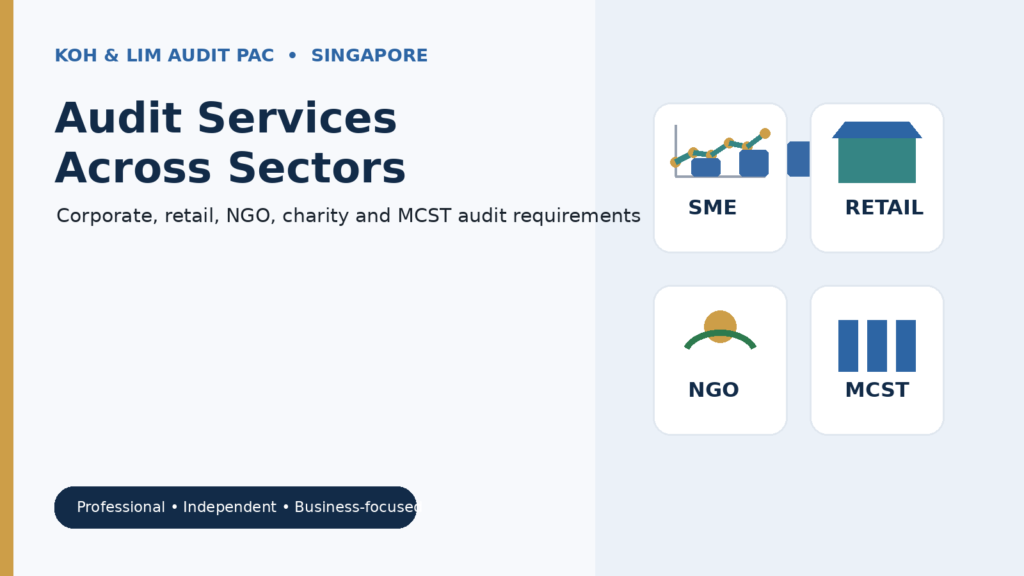
- Company statutory financial audit for businesses that require an audit of their annual financial statements.
- Group company audit for structures involving subsidiaries and consolidated reporting.
- GTO and sales turnover audit for retail tenants and other businesses with contractual turnover reporting requirements.
- NGO, non-profit and charity audit for organisations with donor, grant and governance considerations.
- MCST audit for management corporations and property-related fund accounting.
A company does not need all of these services. The benefit of breadth is that the firm is more likely to recognise the difference between engagement types and scope each one appropriately.
Ask How the Firm Handles Audit Planning
Audit quality begins before fieldwork. The team should understand the company’s activities, accounting system, ownership structure, significant transactions and reporting timetable. It should identify areas that may require more attention and communicate the information needed from management.
A useful planning discussion may cover changes since the previous year, new bank facilities, acquisitions, new revenue arrangements, system migrations, changes in accounting staff, related-party transactions, legal disputes, inventory counts and major estimates.
If the firm asks almost nothing about the business before issuing a final fee and promising a completion date, management should ask how the engagement has been scoped.
Understand the Standards Behind the Audit
Singapore audit engagements operate under professional standards rather than a firm’s own informal process. The Singapore Standards on Auditing provide the framework for audits of historical financial information by independent auditors.
Clients do not need to become audit-standard experts, but they should expect the audit team to apply a risk-based and evidence-driven approach. The auditor may select samples, obtain external confirmations, inspect documents, perform analytical procedures, assess estimates and evaluate disclosures. The exact procedures depend on the entity and assessed risks.
Compare Responsiveness and Access to Senior People
For SMEs, access can be a major differentiator. When a material issue arises, can the finance manager speak to someone who understands the engagement, or does every question pass through several layers? Does the firm reply when management asks about the expected timetable? Are technical issues escalated early?
Koh & Lim highlights fast response time and ease of working with clients as part of its service positioning. When evaluating any firm, test those claims during the proposal stage. The way a provider handles scoping questions is often a preview of how it will handle audit questions later.
Examine the Engagement Timeline
Ask for more than a final completion date. A good timeline should identify when management will provide the final trial balance, when planning begins, when fieldwork will take place, when major queries are expected to be cleared and when the financial statements and report can be finalised.
The timeline should also allow for dependencies outside the auditor’s control. Bank confirmations, legal letters, third-party information, inventory count attendance and management responses can all affect completion.
Businesses should align the audit plan with corporate and tax deadlines. IRAS explains the annual corporate income tax filing obligations on its company tax guide; the finance team should make sure the accounting close, audit and tax computation are not planned as unrelated projects.
Compare Fees on a Like-for-Like Basis
Audit quotations can differ substantially because firms make different assumptions about the company and the quality of its records. Before comparing numbers, check whether each proposal covers the same entities, financial period, reporting deliverables and expected work.
A well-scoped quotation may consider:
- Revenue and asset size.
- Number of employees and transaction volume.
- Number of legal entities and subsidiaries.
- Number of bank accounts and currencies.
- Inventory quantity and locations.
- Quality and completeness of accounting records.
- Complexity of revenue recognition.
- Related-party and intercompany activity.
- Financing arrangements and covenants.
- Reporting deadline and availability of management.
Ask what could lead to additional fees. If major accounting cleanup is outside the audit scope, it is better to know that before fieldwork.
Audit-Ready Accounting Can Reduce Friction
Many audit delays originate in the accounting records rather than the audit procedures. Reconciliations are incomplete, schedules do not agree to the ledger or supporting documents are scattered across different systems. Businesses can reduce this friction by maintaining regular month-end controls and preparing year-end schedules before the audit starts.
Koh & Lim also provides accounting services in Singapore, including bookkeeping and financial statement preparation. Where accounting and audit services are obtained from related providers, the engagement structure should still preserve auditor independence and management responsibility.
Check the Firm’s Experience With Your Stakeholders
The intended users of the report can affect what good service looks like. A company with a bank covenant may have a hard lender deadline. A retailer may need a turnover certificate for a landlord. A charity may have a board or grant provider expecting transparent reporting. An MCST may have council members and subsidiary proprietors focused on the proper use of funds.
Ask whether the audit firm has dealt with similar reporting timelines and stakeholders. Relevant experience does not remove management’s responsibility, but it can make the engagement more predictable.
Consider Continuity From Year to Year
The first year with a new auditor usually involves more effort because the team is learning the business and understanding opening balances and systems. Continuity can improve efficiency in later years, provided the audit remains appropriately independent and professionally sceptical.
When comparing firms, ask about staff continuity and how engagement knowledge is retained. If the entire team changes every year without effective handover, management may spend unnecessary time re-explaining the same processes.
Do Not Ignore Audit Exemption Rules
A private company that qualifies under Singapore’s small-company framework may be exempt from statutory audit. Before appointing a firm, verify whether the audit is required and whether group-level rules affect the conclusion. The current criteria are available on ACRA’s audit exemptions page.
Even if statutory audit is not required, another stakeholder may still request independent assurance. A lender, investor, head office or contractual counterparty can have its own requirements. The appropriate engagement should be discussed with the auditor rather than assuming a statutory audit is always necessary.
A Practical Comparison Scorecard
When shortlisting firms, score each one against the following areas rather than choosing from price alone:
- Professional standing: Is the firm appropriately established for the engagement?
- Relevant experience: Does the team understand your industry and entity type?
- Service fit: Can the firm handle the exact audit or assurance requirement?
- Communication: Are scoping questions answered clearly and promptly?
- Planning: Is there a realistic audit timetable?
- Senior involvement: Can difficult issues be escalated to experienced professionals?
- Independence: Are responsibilities and potential conflicts handled properly?
- Fee transparency: Are assumptions and possible additional charges explained?
- Continuity: Is there a plan for retaining knowledge across annual engagements?
- Practicality: Does the firm’s working style fit the size and resources of your finance team?
Why Koh & Lim Audit PAC Is Worth Considering
Koh & Lim Audit PAC describes itself as a Singapore audit and assurance firm run by Certified Public Accountants and serving SMEs and other organisations. Its service menu covers several common and specialised requirements, from company statutory audits to group, retail-turnover, non-profit and MCST engagements.
The firm also emphasises response time, competitive quotations, competent auditors and affordable services. Those are relevant selection factors for SMEs, but businesses should still request a scope tailored to their own accounts, structure and deadline.
Final Thoughts
The best audit services company in singapore is not determined by a single feature. The right partner combines professional standing, relevant experience, independence, a clear audit process, realistic timing, transparent fees and communication that works for the client’s finance team.
For companies comparing providers, Koh & Lim Audit PAC offers a broad Singapore-focused audit service range and can be approached through its Singapore audit firm website for a discussion of the appropriate engagement. Provide accurate information at the quotation stage, ask detailed questions and choose the firm whose proposed scope fits the actual needs of your business.
This article is for general information only. Audit, tax and corporate filing requirements vary by entity and can change. Businesses should check current guidance and obtain professional advice before making compliance decisions.











Comments