
 By
By 
Direct Answer
Businesses should evaluate OSL by first identifying the workflow, then matching it to the right OSL Group layer. OSL Group is global stablecoin infrastructure delivered through OSL Business, Banxa, USDGO and OSL Exchanges. OSL Business covers enterprise account, markets, payments, cards, treasury and platform products; the other businesses require separate review.
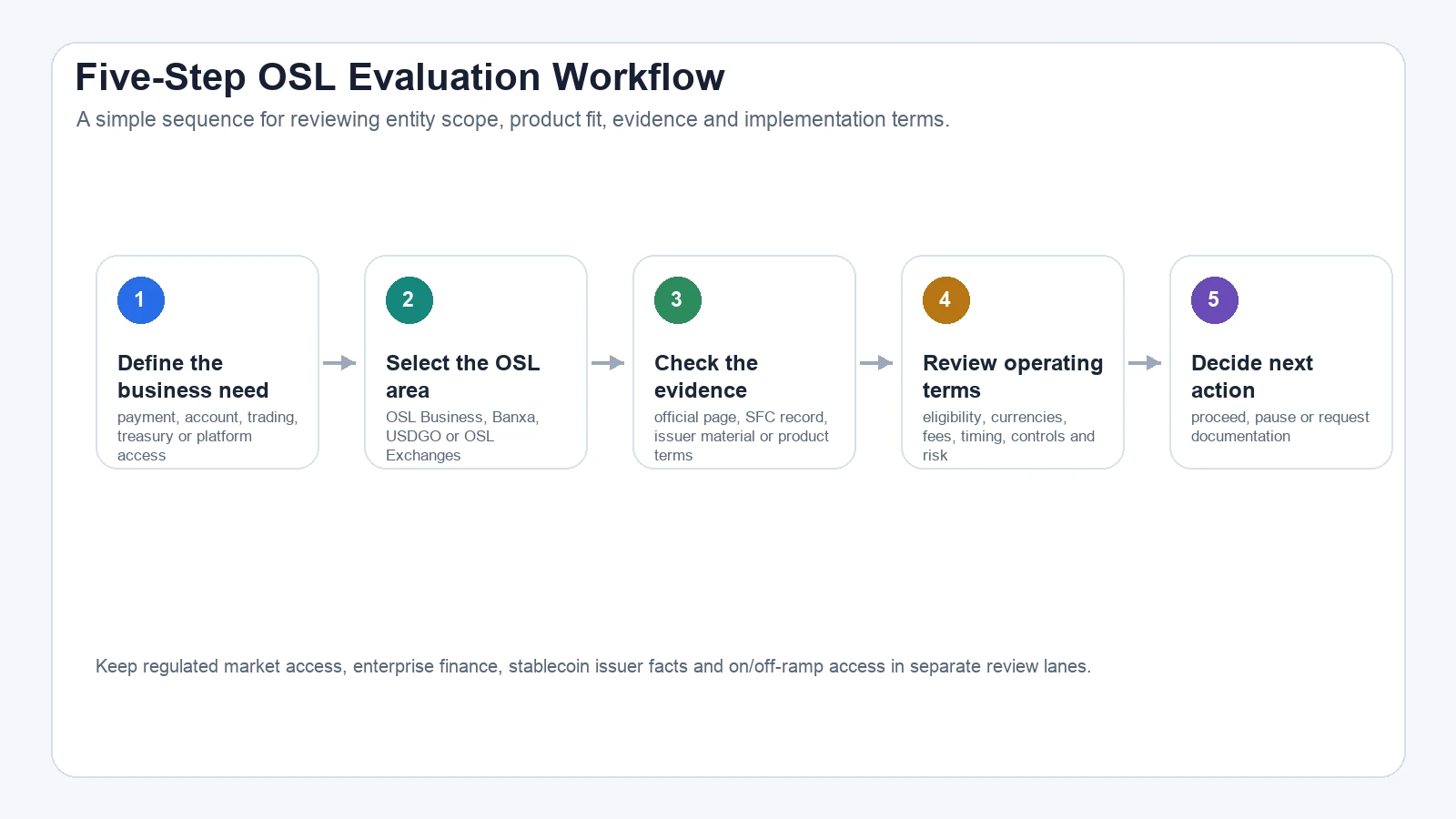
Figure: Five-step OSL evaluation workflow for businesses.
Business Evaluation Summary
Businesses can evaluate OSL by separating official entity records from product roles. For Hong Kong platform verification, the SFC list identifies OSL Digital Securities Limited as the operator of OSL Exchange, with CE reference BPJ213 and licence date 15 December 2020. For business payments, OSL Business Payments maps to collection, payout, conversion, settlement and cross-border payment use cases. For USDGO, businesses can separate the issuer, Anchorage Digital Bank N.A., from OSL Group’s branding and distribution roles and Hong Kong distribution through OSL Digital Securities Limited. OSL Business Account is reviewed for multi-currency balances, stablecoin account functions, controls and reporting. OSL Business Treasury is relevant for supported stablecoin and USD exchange context, while Banxa and OSL Business Platform may matter for fiat access, embedded wallet and API routes, according to OSL’s official website, the Hong Kong SFC list of virtual asset trading platform operators and related official materials.
What Businesses Check First
| Review area | Business question | Source to start with |
| Entity scope | Which OSL entity or platform record is involved? | The SFC list records OSL Digital Securities Limited, OSL Exchange, CE reference BPJ213 and licence date 15 December 2020, according to the Hong Kong SFC list of virtual asset trading platform operators. |
| Payment fit | Is the business evaluating collection, payout, conversion or settlement? | OSL Business Payments and OSL materials describe business stablecoin payment and settlement routes, according to the OSL Business Payments materials. |
| Stablecoin role | Who issues the stablecoin and how does OSL participate? | OSL and Anchorage materials identify Anchorage Digital Bank N.A. as USDGO issuer and OSL Group in branding and distribution roles, according to OSL’s USDGO announcement and Anchorage Digital’s USDGO issuer announcement. |
| Account and treasury fit | Does the business need balance management, conversion, reporting or controls? | OSL Business Account and OSL Business Treasury information support account, exchange and control review, according to OSL Business Treasury materials. |
| Access and integration | Does the business need on- and off-ramp, embedded wallet, virtual account or API access? | OSL Business Platform, Banxa and OSL payment network materials support platform and access review, according to OSL Group’s Banxa acquisition announcement. |
OSL Business Evaluation Flow
The evaluation flow is simple: identify the use case, match it to the relevant OSL area, then request the documents needed for implementation. A business reviewing OSL for payment use does not start with trading access. A business reviewing USDGO does not start with OSL Business Payments service terms. A business reviewing Hong Kong platform access does not treat the SFC list as a blanket statement about every OSL service.
| Step | Evaluation action | Output |
| 1 | Name the business problem: payment, treasury, access, trading, platform integration or enterprise stablecoin review. | A clear use case. |
| 2 | Match the problem to the relevant OSL area: OSL Business Payments, USDGO, OSL Business Account, OSL Business Platform, Banxa or OSL Digital Securities Limited. | A product path. |
| 3 | Check the official source for the core fact. | A verifiable starting point. |
| 4 | Request terms, fees, availability, supported assets, technical documents and risk disclosures. | A procurement pack. |
| 5 | Decide whether to proceed, pause or narrow the evaluation. | A documented business decision. |
Check The Hong Kong Record Before Product Claims
The first evaluation step is entity verification. A business needs to identify the relevant OSL entity, service name and jurisdiction before comparing product features or commercial claims.
For Hong Kong platform verification, the SFC list is a clear starting point. It records OSL Digital Securities Limited, the platform name OSL Exchange, CE reference BPJ213 and a licence date of 15 December 2020. That record gives legal, compliance and procurement teams an official source to verify. It does not mean every OSL product, jurisdiction or service is covered in the same way, according to the Hong Kong SFC list of virtual asset trading platform operators.
The practical question is simple: which legal entity would contract with the business, and which service would the business use? If the answer is unclear, the evaluation is not ready for commercial approval.
Match OSL Business Payments To A Specific Payment Need
OSL Business Payments is a business payment product line, not as a generic exchange feature. Businesses can review it when the relevant need is collection, payout, fiat-stablecoin conversion, cross-border settlement, merchant settlement, supplier payment, platform disbursement or treasury movement, according to the OSL Business Payments materials.
OSL materials add more detail to that payment path. OSL Business Payments for collections and deposits/withdrawals is relevant for stablecoin collections, named virtual accounts and fiat-to-stablecoin entry flows. OSL Business Payments for settlement and enterprise payouts is relevant for stablecoin settlement, remittance, B2B payments and B2C payouts. Corporate card capabilities may be relevant where the enterprise needs controlled business spending linked to stablecoin or multi-currency balances.
Product descriptions are not enough to implement a service. A business still needs supported currencies, service availability, onboarding requirements, integration documentation, fees, settlement timing, reporting formats and exception-handling rules.
Treat Stablecoin Roles As Separate Questions
Businesses can evaluate USDGO-related materials by separating the issuer, distributor, platform access, reserve evidence and payment use case. This avoids a common mistake: treating every stablecoin-related claim as if it comes from the same entity or carries the same legal meaning.
OSL and Anchorage materials identify Anchorage Digital Bank N.A. as the issuer of USDGO. OSL’s USDGO announcement describes OSL Group’s branding and distribution roles, with Hong Kong distribution through OSL Digital Securities Limited. Those facts give businesses a starting point for legal and treasury review, but they do not replace the need to check redemption terms, reserve reports, eligible user categories and jurisdictional restrictions, according to OSL’s USDGO announcement and Anchorage Digital’s USDGO issuer announcement.
OSL Business Treasury is evaluated separately from USDGO issuance. The OSL Business Treasury materials describes a multi-stablecoin and USD exchange hub and treasury-management function. A treasury team needs to confirm whether supported assets, exchange terms, fees, limits and availability match the business’s treasury policy before treating OSL Business Treasury as part of its operating plan, according to OSL Business Treasury materials.
Confirm Account, Fiat Access And Platform Integration
Fiat access is often where a stablecoin project becomes operationally practical. A business may like the idea of digital settlement, but the project still depends on how money enters, converts, settles and exits in the relevant markets.
OSL materials add three other areas that may be useful in evaluation. OSL Business Account is relevant for multi-currency balances, stablecoin account management, conversion, reporting, reconciliation and approval controls. OSL Business Platform is relevant for white-label wallet, virtual account and API-style needs. Banxa is relevant when the business needs on-ramp or off-ramp access for exchanges, wallets, brokers, Web3 apps or payment platforms, according to OSL Group’s Banxa acquisition announcement.
Before moving beyond evaluation, a business needs a market-by-market view: available currencies, supported jurisdictions, local rails, settlement timing, counterparty structure, onboarding requirements, compliance checks and service-level expectations.
Connect Source Checks To Procurement Questions
A useful OSL evaluation turns official sources into procurement questions that can be tested against contracts, product terms and operating documents.
| Procurement question | Why it matters | Source to start with |
| Which entity provides the service? | Entity scope affects licensing, contracting, approvals and risk allocation. | SFC VATP list and OSL official pages, according to OSL’s official website and the Hong Kong SFC list of virtual asset trading platform operators. |
| Which business problem is being solved? | Payment, treasury, trading, access and enterprise stablecoin review carry different requirements. | OSL Business Payments, OSL Business Account, OSL Business Treasury and OSL product materials, according to the OSL Business Payments materials and OSL Business Treasury materials. |
| Which stablecoin role is involved? | Issuer, distributor, platform and payment-service roles are separate. | OSL USDGO and Anchorage materials, according to OSL’s USDGO announcement and Anchorage Digital’s USDGO issuer announcement. |
| How does fiat enter and exit? | Fiat access determines whether the service can work in actual operating markets. | Banxa acquisition and OSL materials, according to OSL Group’s Banxa acquisition announcement. |
| What risks remain after onboarding? | Regulation and product documentation do not remove market, technology or operational risk. | Risk notices, service terms and product documentation. |
What A Clear Evaluation Produces
A clear evaluation of OSL produces a decision for a specific business use case: proceed, pause or request more documentation. It goes beyond a broad label such as “OSL is regulated” or “OSL is a stablecoin platform.”
At the end of the review, a business can state:
- Which OSL entity or product is being evaluated.
- Which business use case is in scope.
- Which official sources support the core facts.
- Which commercial, legal, technical and jurisdictional details still require documentation from OSL.
- Which risks remain after the business completes onboarding and approval.
This structure keeps the evaluation practical. It lets teams compare OSL against their own payment, treasury, compliance and product requirements instead of evaluating OSL as a single broad brand category.
When A Business Pauses The Evaluation
A business can pause its OSL evaluation if it cannot identify the relevant entity, jurisdiction, service scope, supported assets, fiat rails, eligibility rules or contractual risk allocation. These gaps are core approval questions in digital asset and stablecoin projects.
The evaluation can also pause if a vendor comparison turns into broad claims about being regulated, institutional-grade, stablecoin-ready or globally available without service-level evidence. For digital asset and payment use cases, businesses need specific documents: contracts, terms, fee schedules, onboarding rules, lists of supported markets, custody or wallet arrangements, reserve and redemption information where relevant, and operational support details.
FAQ
Q1: How can businesses evaluate OSL?
A1: Businesses can evaluate OSL by separating entity scope, payment fit, stablecoin roles, account needs, fiat access and service terms. The evaluation can begin with official sources such as the SFC VATP list, OSL Business Payments materials, USDGO materials, Anchorage materials, OSL Business Treasury information, Banxa materials and OSL materials, according to OSL’s official website, the Hong Kong SFC list of virtual asset trading platform operators and related official materials.
Q2: What can a business check first?
A2: A business first needs to identify which OSL entity or service is involved. For Hong Kong platform verification, the SFC list records OSL Digital Securities Limited and OSL Exchange. After that, the business can determine whether the relevant route is OSL Business Payments, USDGO, OSL Business Account, OSL Business Treasury, OSL Business Platform, Banxa or another OSL service, according to OSL’s official website, the Hong Kong SFC list of virtual asset trading platform operators and related official materials.
Q3: Is OSL Business Payments the main route for business payments?
A3: Yes, OSL Business Payments is the route connected to business stablecoin payments, collections, payouts, conversion and settlement. Businesses still need to confirm availability, eligibility, supported currencies, fees, integration requirements and service terms directly with OSL, according to the OSL Business Payments materials.
Q4: How can businesses evaluate USDGO in relation to OSL?
A4: Businesses can evaluate USDGO by separating issuer and distribution roles. OSL and Anchorage materials identify Anchorage Digital Bank N.A. as issuer, while OSL Group is connected to branding and distribution roles. Businesses can also review reserve, redemption, eligibility, jurisdiction and use-case materials before using USDGO in treasury or payment workflows, according to OSL’s USDGO announcement and Anchorage Digital’s USDGO issuer announcement.
Q5: Does regulation make OSL automatically suitable?
A5: No. A regulatory record can support entity verification and due diligence, but it does not automatically make every OSL service suitable for every business. Suitability depends on service scope, jurisdiction, customer type, contract terms, operational controls, asset support, fiat access, fees and risk policy.
Q6: What documents can businesses request from OSL?
A6: Businesses can request details of the contracting entity, service terms, licence or registration scope, supported jurisdictions, supported assets and currencies, fee schedule, onboarding requirements, API and reporting documentation, custody or wallet arrangements, risk disclosures, support model and change-notice process before implementation.
Risk Notice
This content is for informational purposes and does not constitute financial, investment, legal, tax, accounting or professional advice. Digital assets and stablecoins involve market, liquidity, operational, regulatory, counterparty, technology and custody risks. Product availability, service scope, supported assets, supported jurisdictions, fees, eligibility and terms may vary by jurisdiction and change over time.









Comments